The Town of Natick wants to convert a natural grass playing field to artificial turf. There is a growing body of evidence that artificial turf has potential risks to our health and to our town budget.
We’re working on a proposal for a moratorium on any new artificial turf.
Learn about artificial turf and let our town representatives know that you support the moratorium.
Email the Select Board and the Natick School Committee (schoolcommittee@natickps.org).
Email your Town Meeting Representatives. Find their email addresses here.
READ ON ABOUT HEALTH RISKS, COSTS, CLIMATE/ENVIRONMENTAL EFFECTS, AND WHAT OTHER MA TOWNS ARE DOING.
HEALTH RISKS
PFAS: Playing on artificial turf can expose our children to PFAS (“forever chemicals”) as well as other chemicals known to be carcinogenic or otherwise hazardous to our health. One study found PFAS on children’s skin after playing on artificial turf.
Heat: The playing surface of artificial turf can get up to 60 degrees hotter than the surrounding temperatures. The Health Department in Natick recorded temperatures on the artificial turf of 150 degrees when it was 90 degrees out. This increases the risk of heat exhaustion and skin burns.
For more details on health risks, see the article from the Mount Sinai School of Medicine.
Here’s a quote: “The Mount Sinai Children’s Environmental Health Center at the Institute for Climate Change, Environmental Health, and Exposomics recommends against the installation of artificial turf playing surfaces and fields due to the uncertainties surrounding the safety of these products and the potential for dangerous heat and chemical exposures.”
COSTS
Artificial Turf can be twice, even 3 times more expensive than a natural turf field when you look at the total lifecycle cost. Artificial turf fields need to be resurfaced on average every 8-10 years.
For example, the Kennedy Middle School in Natick artificial field cost $1,200,000.
When Natick’s Memorial Field’s artificial turf needed to be resurfaced, it cost $600,000.
On an annual basis, an AT field costs $65,000-$109,000 while a natural grass field costs $33,000-$50,000.
For more details on cost, see this cost analysis by TURI at UMASS Lowell and this one by Safe Healthy Playing fields.
CLIMATE AND ENVIRONMENTAL EFFECTS
Microplastics: Each artificial turf field loses 0.5 to 8.0% of its blades annually. This leads to 200 to 3200 lbs. of plastic into our environment per year. These microplastics migrate off the field into air, soil, and waterways.
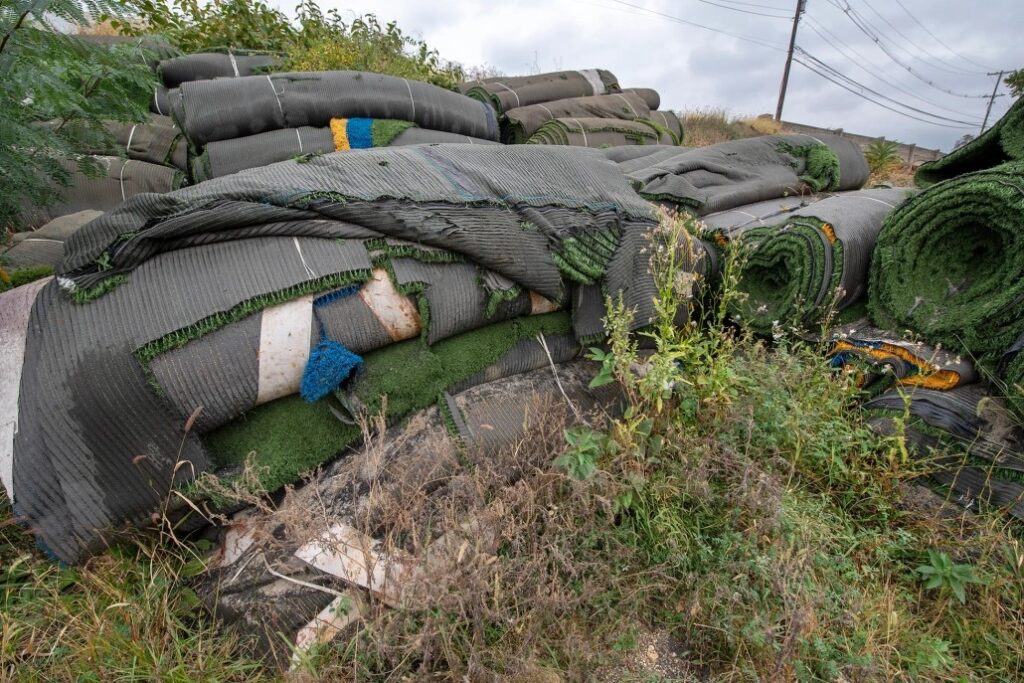
Landfills: Billions of pounds of artificial turf are already in our landfills where it continues to leach harmful chemicals and more turf is headed the landfills across the US every day.
Fossil Fuels: An average artificial turf field “contains 40,000 lbs. of plastic carpeting and 400,000 lbs. of infill, all of which are made from fossil fuels.” (see this link)
CO2: The total lifecycle cost of constructing, maintaining and replacing an artificial turf field (after 8-10 years) can generate up to 527 tons of CO2.
Artificial turf “emits high levels of methane, a potent greenhouse gas, and sheds microplastics and other chemicals into waterways.” (see this link)
WHAT OTHER MA TOWNS ARE DOING
This video shows three MA communities, Springfield, Marblehead, and Martha’s Vineyard, that are managing their natural grass fields organically.
Wayland recently passed a 3-year moratorium and just built a new natural grass field.
Marblehead has been using natural grass fields since 2002.
Martha’s Vineyard has managing 4 community’s fields organically since 2017.
Springfield managed 67 acres of natural grass fields organically.